Crypto marketing in 2026 looks almost nothing like it did in 2022. The bull-market playbook has been replaced by something more thoughtful, more disciplined, and more expensive. The projects winning attention in 2026 are the ones building for the long term.
This is Blokhaus's annual report on what's actually working in crypto, blockchain, and Web3 marketing right now — based on what we've seen building campaigns across Solana, NEAR, Algorand, ZKsync, Tezos, and more.
Five macro trends define the year:
- Consolidation at the top. The gap between protocols with sustained marketing investment and those without has become unbridgeable.
- Community-first is the only playbook that works. Top-down campaigns are consistently underperforming community-led ones by a widening margin.
- AI has quietly eaten the content middle. The tier-two blog-and-social content that dominated 2022–2024 is commoditized.
- Experiential is back, with a focus shift. IRL activations are outperforming most digital ads, but the format has changed.
- The attention economy has re-centered on utility. Hype without product has a shorter half-life than at any point in crypto's history.
The rest of this report breaks each of these down with case studies and tactical implications.
The macro shift: consolidation and maturation
Crypto marketing has matured. That's the short version.
The long version: the number of protocols actively marketing has dropped sharply from its 2022 peak, but the ones that remain are spending more, testing more, and operating with marketing discipline that looks a lot like traditional tech marketing with crypto-native adaptations.
The implication: the ceiling on what a well-run crypto marketing program can achieve has gone up. The floor — what you can get away with — has moved up with it.
What "mature" looks like in 2026
- Dedicated in-house marketing functions. Protocols now have CMOs, brand leads, and marketing operations roles. In 2021 this was almost unheard of.
- Multi-year brand strategy documents. Top protocols plan in quarters and years, not launch cycles.
- Integrated attribution. The better-funded protocols can trace a developer sign-up back to the content piece that sourced it.
- Spend on brand, not just acquisition. Protocols are starting to invest in long-horizon brand building — out-of-home, partnerships, earned media — not just performance marketing.
Who's getting left behind
Protocols that treat marketing as a post-launch afterthought, or as a function that begins and ends with a Twitter account, are falling off the competitive map. The competitive distance between top-decile and bottom-decile protocols (measured by developer sign-ups, ecosystem activity, and brand search lift) has widened materially over the last 18 months.
What's actually working in 2026
Community-led brand campaigns
The single biggest shift since 2024 is the move from top-down campaigns (protocol foundation pushes message outward) to community-first campaigns (protocol foundation amplifies signal already present in the community).
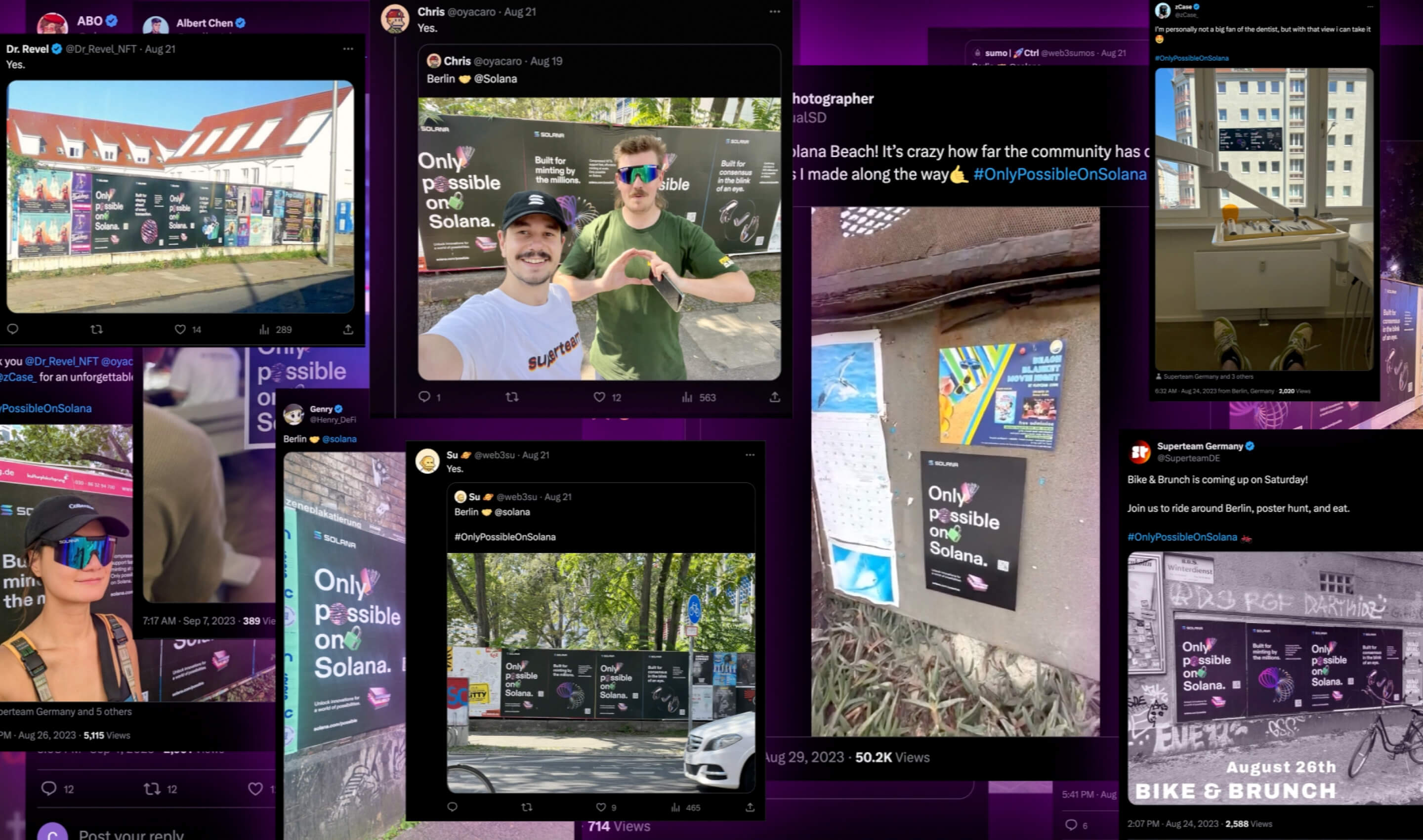
The success case is Only Possible on Solana — a campaign that worked specifically because it didn't invent anything. It surfaced a phrase already circulating in the community and built a campaign system that the community could carry on the foundation's behalf.
The failure case is the high-production campaign that tested well in focus groups but had negligible community pickup because the community had no hand in shaping it. We've seen this pattern repeated across protocols this year.
The rule in 2026: if the community wouldn't say it themselves, don't say it for them.
Experiential activations that anchor a narrative
In-person activations are outperforming most digital media in 2026, but the format has evolved. The old model was a booth at a conference. The new model is a self-contained brand experience designed to generate a specific emotional or cognitive outcome.
Examples we've built or seen work:
- Elastic House (ZKsync at ETH Denver 2025): an activation that turned an abstract scaling solution into a physical experience builders could feel
- Solana x Art Basel: a multi-year series translating blockchain into the visual language of contemporary art
- Tezos × Art Basel: the Webby-winning "Performance in Code" activation that embedded the chain into a cultural moment
What connects them: each activation was designed around a narrative outcome, not a brand moment. Attendees walked away with a feeling or a framing, not a lanyard.
Long-form content that ranks in AI
This is the quiet revolution of 2026. With AI Overviews cannibalizing traditional SEO, the content that still earns traffic is the content that AI systems cite when answering user questions.
That means:
- Depth over frequency. A single 3,000-word authoritative piece is worth more than twenty 800-word blog posts.
- Original data and frameworks. AI systems cite sources with unique information. Aggregator content doesn't make the citations.
- Clear structural authority signals. Named authors, publication dates, citations, expertise markers.
The protocols seeing content-driven growth in 2026 aren't producing more content. They're producing fewer, deeper, better-sourced pieces designed specifically to be cited.
Developer-first marketing
Crypto marketing is, at its core, developer marketing. In 2026, the protocols winning the long game are the ones treating developers as the primary customer — with documentation, tutorials, hackathons, grants, and community support that dwarfs their consumer marketing spend.
The insight: developer mindshare compounds. Every developer who ships on your chain recruits more developers, advocates in forums, and generates reference material. It's the one marketing investment in crypto that continues paying out after the budget ends.
What's not working anymore
Influencer campaigns as the primary strategy
The ROI of crypto influencer marketing has collapsed. Audiences have gotten significantly better at pattern-matching paid posts, and platform algorithms have gotten worse at surfacing them.
Influencers still have a role — for product launches, ecosystem awareness, community hype moments — but as the centerpiece of a marketing strategy, they're a 2022 tactic being applied to a 2026 market.
Airdrop-driven growth
Airdrop farming has become professionalized to the point of meaninglessness. The users who show up for an airdrop bounce the moment rewards stop. Retention on airdrop-acquired users is dramatically lower than on organically acquired users — by an order of magnitude in the data we've seen.
The protocols still using airdrops as their primary growth lever are inflating their on-chain metrics while losing the long game.
Generic "Web3 is the future" messaging
In 2022, messaging about "the future of money" or "Web3 changes everything" worked because the category was new and the audience was forgiving. In 2026, that messaging sounds like a 2010s startup pitch-deck cliché — broad, unfalsifiable, and nearly meaningless.
The protocols getting attention in 2026 are specific. They're not "building the future." They're "making payments that clear in 400ms." They're "enabling provable randomness at scale." They're "making Ethereum feel like the internet."
Specificity is the new brand currency.
Hype without product
The pre-launch hype cycle — big announcement, loud marketing, slow rollout — has broken. Communities now expect working product before the marketing push, and they punish projects that reverse the order.
The rise of AI in crypto marketing
AI has changed crypto marketing in three specific ways:
1. AI has commoditized the content middle
Mid-tier blog content, basic social copy, generic newsletters — all of it has been replaced by AI output across the industry. The baseline quality of content has gone up. The distinctiveness of content has gone down.
This means the bar for content that actually stands out has risen dramatically. Generic is worse than silence in 2026, because silence at least doesn't waste attention.
2. AI has changed how people find information
With AI Overviews and AI-first search interfaces capturing a growing share of queries, the click-through rates on traditional search results have cratered. The protocols that adapt are the ones publishing content designed to be cited by AI, not just indexed by search. That means deeper content, unique data, and strong structural signals.
3. AI has made real human voice more valuable
The counterintuitive effect of AI content flooding the market is that genuine human perspective has become a premium signal. A well-written founder thread, a thoughtful long-form post from a known builder, a podcast appearance with real opinions — these cut through exactly because they can't be mass-produced.
The protocols leaning into original human voice (founder visibility, internal subject-matter experts, authentic community ambassadors) are outperforming the ones relying on faceless brand output.
Platform shifts
X is still the center of gravity — but less so
X (Twitter) remains the primary platform for crypto-native conversation, but its dominance is softening. The on-platform experience is more fragmented, and the broadcast model of 2022 ("post to followers, expect engagement") works less reliably.
The effective strategy on X in 2026 is narrower: be part of specific conversations rather than broadcasting into the general feed.
Farcaster matters — but hasn't taken over
Farcaster has real traction among crypto-native builders and an engaged core community. It hasn't displaced X as the default platform, and it probably won't. But for certain audiences — protocol developers, NFT artists, specific ecosystems — it now delivers better engagement-per-follower than X.
YouTube and long-form video are undervalued
Long-form video continues to outperform short-form for education-heavy crypto topics, and YouTube's algorithm rewards creators who go deep. Protocols that invest in a single strong YouTube presence (founder-led, documentary-style, or explainer-format) are seeing outsized returns relative to the content cost.
Traditional media partnerships are back
Earned media in mainstream tech publications (Bloomberg, Wired, The Verge) drives more high-value conversions than paid crypto media in 2026. It's harder to get, but the quality of attention is disproportionately high.
Predictions for H2 2026 and beyond
- Crypto marketing budgets will consolidate further. The middle tier of protocols will continue to lose ground. The top ten will take more share.
- The line between crypto and fintech marketing will blur. As protocols integrate with banks and payment providers, the audiences and tactics will increasingly overlap with traditional fintech marketing.
- AI-native marketing operations will become table stakes. Protocols not running AI-assisted content workflows, ops automation, and attribution by end of 2026 will be at a structural cost disadvantage.
- Community-led campaigns will be systematized. What was organic in 2022–2024 is now a discipline. Expect playbooks, case studies, and dedicated community-first campaign agencies.
- Brand quality will become a competitive moat. In a market where product quality is increasingly comparable and technical claims are increasingly commoditized, the brand that feels right wins.
The 2026 playbook
For protocols and Web3 brands trying to build marketing programs that work in 2026, here's the short version of everything above:
- Start with the community. If the community isn't already saying what you want to say, earn the right to say it yourself first.
- Invest in depth, not volume. One great piece beats ten average ones. This is true for content, video, events, and ads.
- Build for the AI citation layer. Publish content designed to be found and cited in a search environment that's less about ranking and more about sourcing.
- Treat developers as the primary audience. Developer mindshare is the one marketing investment that compounds.
- Earn technical credibility before reaching for mainstream. Especially in ZK, infrastructure, and deep-tech categories.
- Anchor everything with a real-world activation. Digital-only campaigns leave less impression than they used to. IRL moments translate to digital momentum — not the other way around.
- Measure what matters. Followers are vanity. Developer sign-ups, ecosystem project launches, brand search lift — those are signal.
About this report
This report draws on Blokhaus's work across crypto, Web3, and fintech marketing — including campaigns for Solana ("Only Possible on Solana"), NEAR, Algorand, ZKsync (Elastic House), Tezos, Celestia, and more. The 2026 trends reflect what we've seen building campaigns across the crypto, Web3, and fintech landscape over the last 18 months.
If you're building in crypto, Web3, AI, or fintech and want a marketing partner that knows the ground truth of what's working, let's talk →