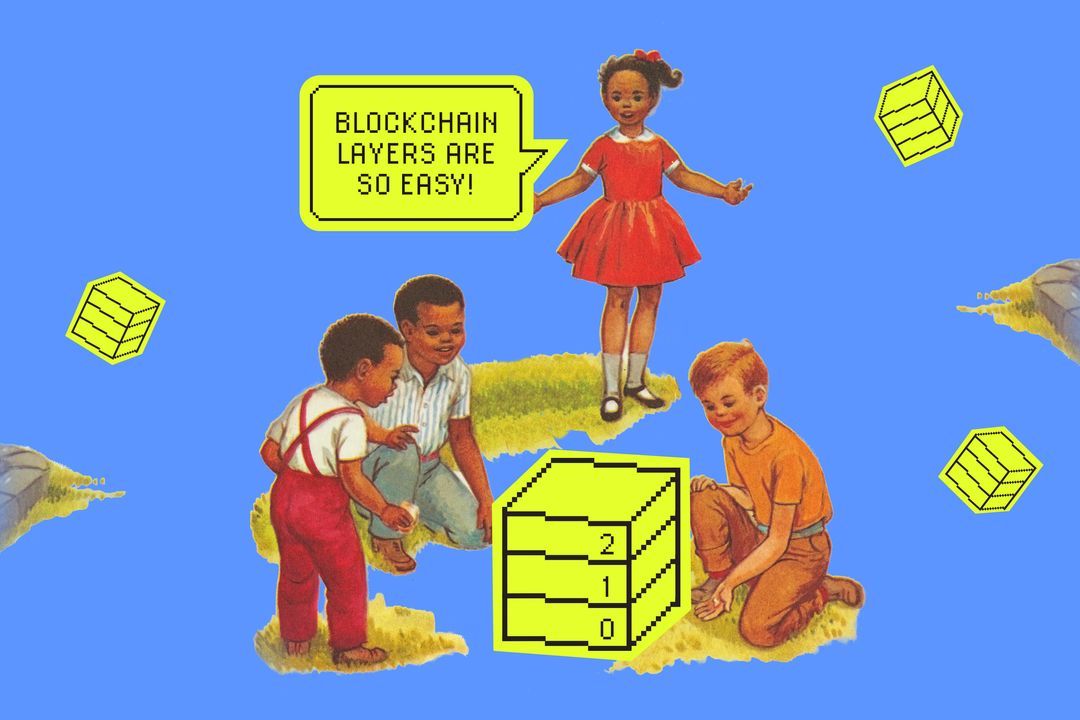
Blockchain architecture is organized in layers — and understanding which layer does what makes the rest of the space considerably less confusing.
References to "layer-0," "layer-1," and "layer-2" appear constantly in blockchain literature. The concept is actually straightforward once you have a mental model for it: each layer sits on top of the previous one, with different responsibilities and trade-offs. Here's a plain-English guide.
Layer-1: Where most of the action happens
If you've heard of a blockchain, it's almost certainly a Layer-1. Ethereum, Solana, Cardano, Tezos, Algorand — these are all L1 chains. Layer-1 is where transactions happen, where assets are exchanged, and where decentralized applications are built and deployed. Each L1 has its own native coin (ETH for Ethereum, SOL for Solana, XTZ for Tezos) used for transaction fees and network participation.
For most users and developers, L1 is the blockchain. But as the space has matured, additional layers have emerged both beneath and on top of it.
Layer-2: Scaling solutions
The core challenge of any L1 blockchain is scalability. Processing transactions takes time, and on a busy network, it takes more time and costs more. Layer-2 solutions address this by taking transactions off the main L1 chain, processing them in a faster environment, and settling the results back to L1 periodically.
For Bitcoin, the Lightning Network is the primary L2. For Ethereum, Optimism, Arbitrum, and Polygon are the most prominent. For Tezos, it's Smart Rollups. The trade-off: L2s are typically more centralized than L1s, which is how they achieve their speed. The Blockchain Trilemma — the observation that decentralization, security, and scalability can't all be maximized simultaneously — is the reason L2s exist.
Layer-0: The foundation beneath the foundation
A Layer-0 is a protocol that sits beneath the L1, primarily providing two things: shared security and interoperability. Rather than each L1 needing to maintain its own validator set, an L0 allows multiple L1 blockchains (called parachains in Polkadot's terminology) to share a common pool of validators, significantly increasing security without each chain bearing the full cost.
Polkadot's Relay Chain is the clearest example of a true L0. Cosmos and Avalanche also fit within a broader definition of the category, with a particular emphasis on interoperability — making it easier for different blockchains to communicate with one another.
Where this is heading
The concept of a "Layer-3" has begun circulating — though it's not yet formally defined. Whether it becomes mainstream and what it will mean when it does remains to be seen. For now, understanding the L0-L1-L2 stack is enough to make sense of most conversations about blockchain architecture.