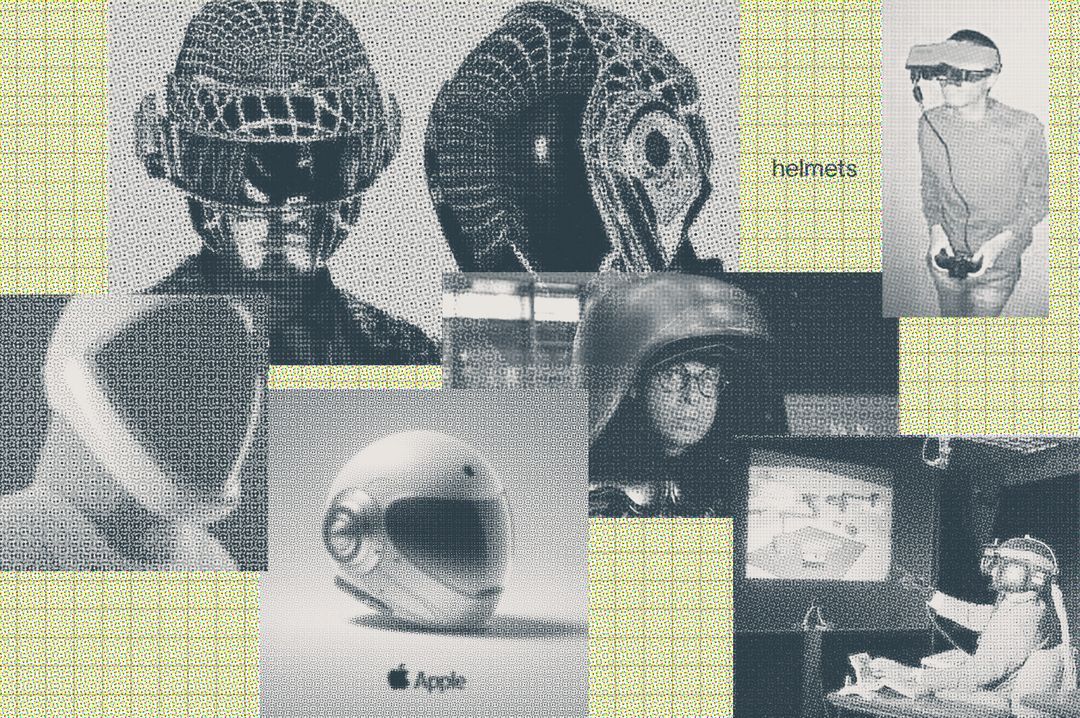
The future of spatial computing may well be tiny, but the present should be big, with helmets. Why VR/AR's near-term success depends on full-headgear devices.
In a conversation on X, I responded to a particularly goofy image of someone wearing the soon-to-ship Apple Vision Pro. I declared that the chunky goggle thing might as well be a helmet. That comment caught the attention of online personality @0xgaut, who replied with an AI-generated render of a sleek, Apple-designed helmet. Elon Musk responded with a fire emoji. Love him or hate him — hear me out.
A history of face tech falling flat
History is full of wearable tech that missed the mark: Nintendo's Virtual Boy, Google Glass, Oculus. The pattern is clear — people resist technology that interferes with their faces. Our faces are our primary interface with the world, essential for verbal and nonverbal communication. Disrupt that, and things get awkward fast.
The case for going big
Tech solutions tend to work best at two extremes: tiny (invisible, unobtrusive) or big (deliberately separate from your natural interface). Since small still isn't small enough, maybe the answer is to go big — and that's precisely where helmets come in, an option strangely overlooked until now.
Total face coverage beats partial coverage any day. A helmet signals "do not disturb" to those around you. It offers complete privacy, making it more adaptable for public use. And it has a cool factor that the Vision Pro's awkward goggle form simply doesn't. Helmets are weather-friendly, immersive audio-friendly, and they don't require you to make eye contact with a camera sensor strapped to someone else's face.
The thought experiment
If you had to choose a wearable spatial computer for daily use — the Apple Vision Pro or a full-face-covering helmet — which would you pick? I'd bet many would lean toward the helmet, especially in a world where mixed reality hasn't fully arrived and the alternative makes you look, well, a bit silly.
One day, walking around without a helmet might seem as strange as listing your phone number in a public directory. Tech giants would do well not to sleep on the humble, mighty helmet as the form factor for the present of spatial computing. It's not just a device — it's a game-changer for privacy, comfort, and utility in a mixed-reality world, at least until you can go tiny.